Fishing Weather — Understand It, Catch More
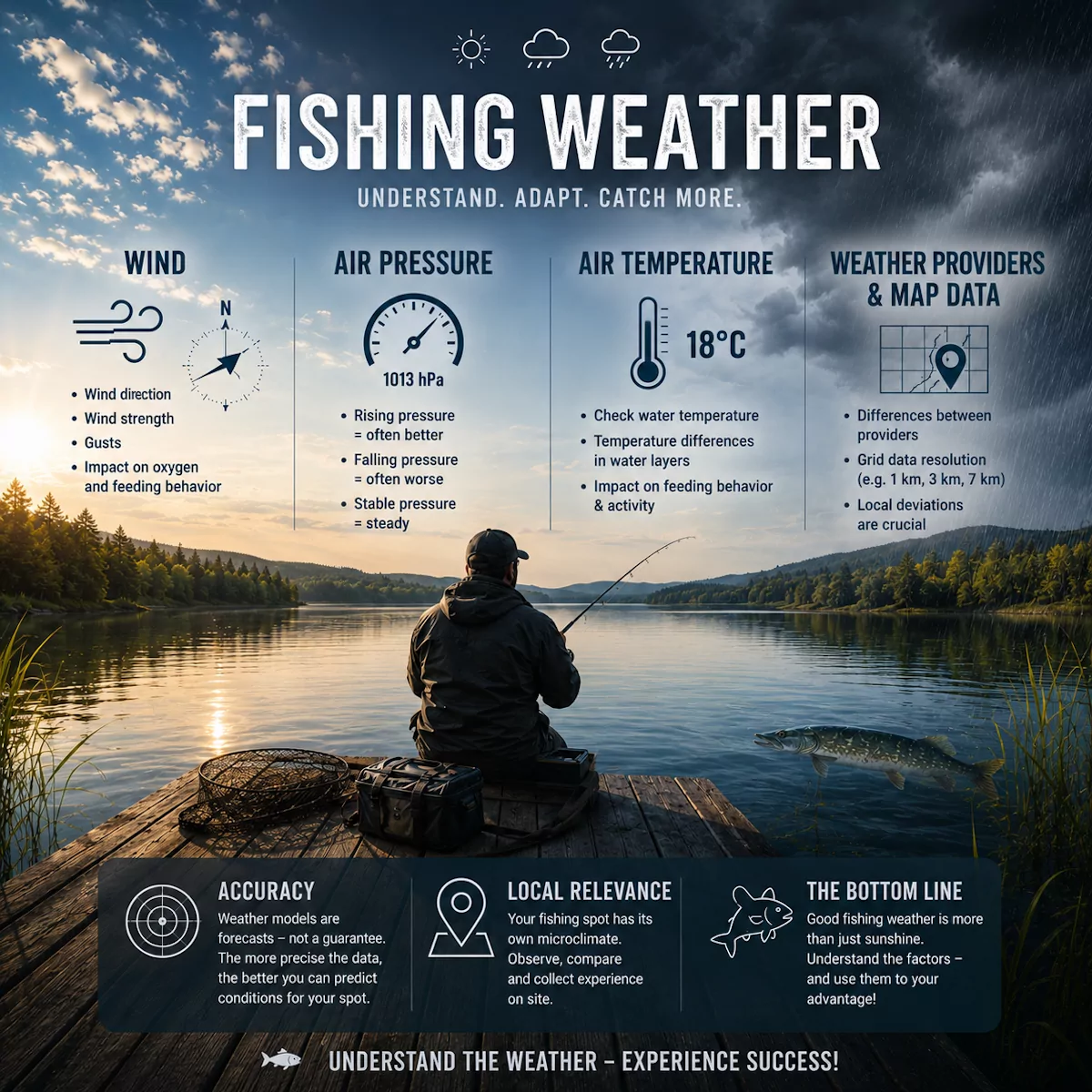
Weather shapes how fish feed. Pressure changes, wind and temperature often decide whether you have a top session or a quiet day on the water. This page explains the most important weather factors when fishing and answers the most common question: Why do different weather apps show different values?
On this page
- Why do different weather apps show different values?
- Where does the weather data come from?
- Automatic weather capture in AngelStratege
- Air pressure — impact on feeding behaviour
- Air temperature — how temperature shapes activity
- Wind — often underestimated, often decisive
- Cloud cover — why it is captured manually
- Moon phase and fishing
- Other values you enter manually
- Weather and fishing success: your personal evaluation
Why do different weather apps show different values?
Anyone comparing fishing weather from several sources rarely sees the same numbers. There are three solid reasons for that:
- Different weather models. Every weather app uses its own model, some combine several. Different models calculate pressure, temperature and wind with different assumptions.
- Different measurement stations. Some apps pull direct station data (for example from national weather services), others use purely model-derived values. A station 30 km away will report different numbers than the interpolated model output for your exact spot.
- Grid resolution. Weather models divide the world into grid cells, with typical edge lengths between 1 and 25 km. Your spot sits somewhere INSIDE one of these cells. The model delivers the average value for the whole cell — not for your precise location.
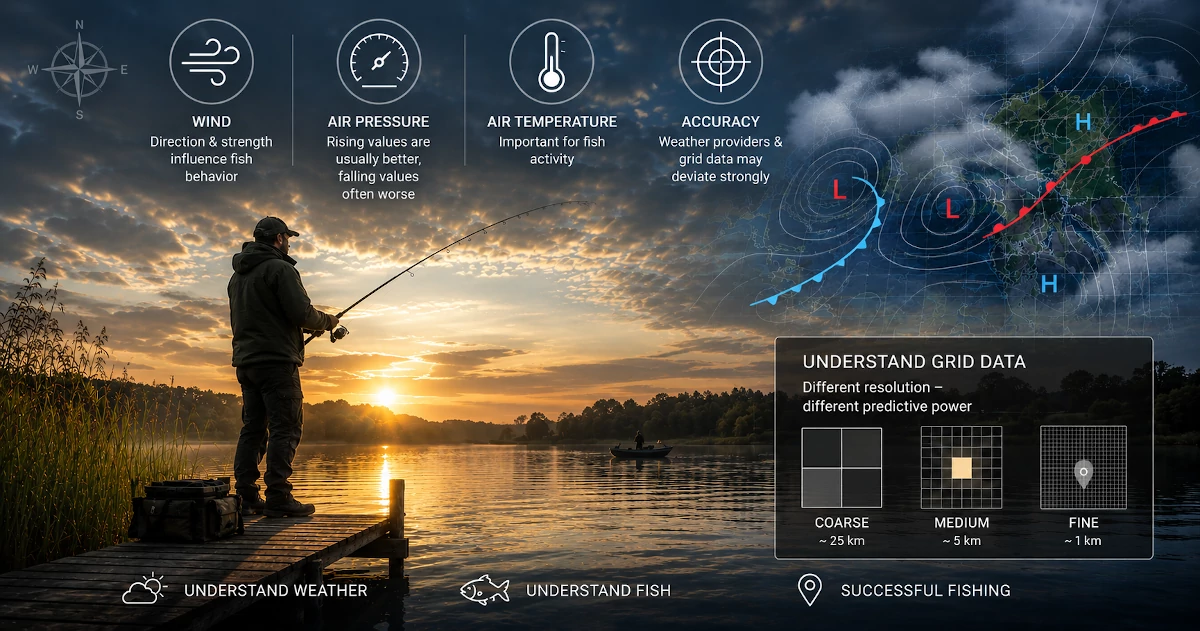
Typical differences between apps:
- Temperature: 1–3 °C
- Air pressure: 4–8 hPa (plus station-level vs. sea-level reduced, see the air pressure chapter)
- Wind speed: 2–5 km/h
Why this does not hurt the app logic:
What matters is not that the value matches your onboard barometer or another app to the hPa. What matters is that the SAME provider is used for ALL of your sessions. A systematic offset of, say, 4 hPa cancels out when you compare your own sessions against each other. Your pattern "good bite when pressure has dropped by X hPa" stays clearly visible — even if the absolute hPa value does not line up with another weather site.
Where does the weather data come from?
Since version 1.2.2 AngelStratege uses Open-Meteo exclusively as its weather provider. Open-Meteo is a free-to-use weather model with global coverage, solid data quality and no sign-up required.
For every session, catch and bite a single data record is fetched at the moment in question from the same provider and stored in the app. The values will not change later — they are a snapshot.
Automatic weather capture in AngelStratege
AngelStratege captures the fishing weather automatically — you do not have to enter anything by hand. For every session the values are pulled both at the start and at the end, so weather trends during the session become visible.
Captured weather data
- Air pressure — station-level pressure plus the trend over the last few hours
- Air temperature — actual and feels-like
- Wind — speed, direction and gusts
- Cloud cover — percentage from the model (manual correction possible)
- Precipitation — rain, snow
- Humidity — relative humidity
Current conditions
On the home screen AngelStratege shows the current weather conditions for your location. On top of that you get an assessment of how favourable the conditions are for fishing — calibrated against your previous sessions at this water. More details in the personal bite index.
Air pressure — impact on feeding behaviour
Air pressure is one of the most important weather factors when fishing. Many species react sensitively to changes because pressure has a direct influence on their swim bladder and overall comfort.
Why is air pressure important for fish?
Fish have a swim bladder that lets them regulate buoyancy. Changes in air pressure act indirectly on the pressure in the water and force fish to constantly adjust. Fast or strong pressure changes mean stress and clearly affect feeding behaviour.
Typical effects
- Stable air pressure — calm, predictable behaviour
- Quickly rising pressure ↑ — often cautious bites
- Slowly falling pressure ↓ — often raised activity
What matters for anglers
The deciding factor is usually not the absolute pressure value but how it changes over time. A moderate drop in pressure ahead of a weather change can trigger a good feeding window, while abrupt swings tend to act negatively.
Combined with other factors like wind, temperature and season, air pressure delivers valuable input for your fishing strategy.
Station-level pressure instead of sea-level pressure
AngelStratege shows the air pressure that actually presses down on the water surface at your spot (station-level pressure). This is the pressure that acts on the fish's swim bladder — and therefore on their feeding behaviour.
Weather apps and TV forecasts usually show pressure reduced to sea level (MSLP — mean sea-level pressure). That value is useful for comparing high- and low-pressure systems across large regions, but it has nothing to do with the real pressure at your lake.
Rule of thumb: every 100 m of altitude lowers air pressure by roughly 12 hPa. A mountain lake at 1000 m has a permanent offset of about 115 hPa below the sea-level pressure values from the news — that is physically correct, not wrong.
For evaluating trends (rising/falling) the choice does not matter, because the altitude correction is constant. For absolute comparisons between waters and for matching the reading on your phone's barometer, station-level pressure is the right quantity.
Air temperature — how temperature shapes feeding behaviour
Water temperature is one of the most important factors in fishing. As cold-blooded animals, fish depend directly on the temperature of their surroundings — it drives metabolism, activity and therefore feeding behaviour.
Why temperature is so decisive
Fish cannot regulate their body temperature themselves. It tracks the water temperature. That has direct consequences:
- Metabolism speeds up or slows down
- Food intake goes up or down
- Their choice of location changes (depth, current, shade)
- Spawning and activity phases get triggered
Temperature & metabolism
The body functions of fish depend directly on water temperature. Warmer water means a faster metabolism — the fish need more food and are more active. Colder water slows metabolism — fish eat less and move sparingly.
Basic rule: the warmer the water (within the species-appropriate range), the more active the fish — and the higher your chance of bites.
- Below 8 °C — metabolism strongly slowed, low activity
- 8–14 °C — activity increasing, good windows possible
- 14–22 °C — optimal range for many native species
- Above 22 °C — stress for cold-loving species, possible oxygen depletion
Optimal temperature ranges
Below 8 °C — many species are lethargic. Exception: burbot spawn in winter and are especially active in the cold. In general, slow presentations near the bottom are the way to go.
8–14 °C — water temperature rises into this range in spring or drops into it in autumn. Predators like pike and zander become active. Carp start to feed. Trout are in their comfort zone.
14–22 °C — the most productive range for most freshwater fish. Coarse fish feed intensively, predators hunt actively. Insect activity rises — good news for fly fishers.
Above 22 °C — cold-loving species (trout, grayling) retreat to deeper, cooler zones. Oxygen levels in the water drop. Fish are more active in the morning and evening. Night fishing can be more productive than the daytime.
Seasons & temperature progression
- Spring — rising temperatures trigger feeding activity after winter. Shallow areas warm up first; that is where the fish gather. Spawning season for many species.
- Summer — peak water temperatures. A thermocline forms in deeper waters. Early mornings and late evenings are often the most productive windows.
- Autumn — falling temperatures kick off an intense feeding phase. Fish build up reserves for winter. Often the best season of the year to fish.
- Winter — lowest activity for most species. Fish hold deep and barely move. Slow presentations and finesse rigs are the answer.
Thermocline: the invisible boundary in the water
In still waters a temperature layering forms in summer: the upper layer (epilimnion) is warm, the lower one (hypolimnion) is cold. Between them sits the transition layer (thermocline), where the temperature drops abruptly. Fish often hold along this boundary because oxygen and food conditions tend to be good here. Find the thermocline, and you often find the fish.
Temperature is not a single number
- Trend — is the temperature rising or falling? A rising temperature in spring is a strong activity trigger.
- Stability — stable temperatures over several days produce predictable behaviour. Sudden swings throw the fish off.
- Combination — temperature works together with air pressure, wind and time of day. The best feeding windows arise from a stack of favourable factors.
Common misconceptions
- "Warm water is always good." — Not for every species. Trout and other salmonids suffer at high temperatures. Each species has its optimal range.
- "Fishing in winter is not worth it." — Many species are less active, yes, but not inactive. With the right technique and presentation, good catches are possible.
- "Air temperature equals water temperature." — Water reacts far more slowly than air. After a warm day the water is not warmer right away. The alignment takes hours to days.
Bottom line
Water temperature is a central factor for your fishing strategy. If you understand how temperature drives metabolism, location choice and feeding behaviour, you can plan more deliberately and make the right calls on the water.
Wind — often underestimated, often decisive
Wind is one of the most underestimated influences in fishing. It does not act directly on the fish; it changes water movement, oxygen, temperature distribution, food and visibility — and through that, the behaviour of the fish.
Wind is not a simple "good" or "bad" factor. Its effect depends strongly on water type, strength, direction and duration.
What wind does in the water
Water movement & mixing
- Wind creates current and surface movement
- Warm and cold water get mixed
- Oxygen is drawn in more strongly
→ More activity for coarse fish and baitfish. Predators follow the food. Especially relevant in still waters like lakes, ponds and reservoirs.
Oxygen content
- Wind boosts oxygen uptake at the surface
- Banks the wind is blowing onto often show higher oxygen levels
→ Fish hold more often in these zones. Particularly relevant in summer and at warm water temperatures.
Temperature distribution
- Persistent wind can push warm surface water aside
- Cooler deep water can rise to the top
→ Short-term location changes for the fish. Feeding windows can shift, but they do not necessarily disappear.
Wind direction — often more important than strength
Onshore wind (blowing towards the bank)
- Drives food, plankton and small baitfish to the shore
- Raises activity in shallow water
→ Typical hot zones: windward bays, shallow margins and weed edges close to the bank.
Offshore wind (blowing away from the bank)
- Food is pulled away from the bank
- Fish hold deeper or further out more often
→ Bank fishing can get harder. Boat anglers tend to benefit more.
Wind strength
Light wind — barely any water movement, clear viewing conditions for the fish. Cautious bites, fine and discreet presentations needed.
Moderate wind — light waves, broken light. Often ideal: fish feel safer, predators become more active. More missed bites, but more chances overall.
Strong wind — strong turbidity, high energy cost for the fish. Possible, but demanding: location choice is decisive. Shelters and lee sides gain importance.
Different effect per water type
- Still waters — wind is a central factor. It dictates spots, activity zones and feeding windows.
- Flowing waters — wind acts mostly indirectly. The current remains the dominant factor. Mostly relevant for surface movement, light refraction and insect drift.
Wind is a time factor
The duration of the wind is often more important than the current strength.
- Short gusts usually have little effect
- Several hours or days of the same wind direction can shift hotspots
- Wind shifts often come with pressure changes — both factors should be looked at together
Bottom line
- Wind influences the where, not the whether
- It shifts activity, but does not prevent it
- Your own experience is worth more than blanket rules
The best wind is the one under which you have already seen activity at your own water.
Cloud cover — why is it captured manually?
Cloud cover can be an important criterion for anglers — especially for lure fishers. At the same time it is one of the hardest weather values to measure precisely.
Why are model values inaccurate?
Weather apps show a percentage for cloud cover, but the number comes from weather models. Those models work in grid cells several kilometres wide and cannot capture what the sky actually looks like directly above your spot.
- Two locations only a few kilometres apart can have entirely different cloud cover.
- Short cloud bands or breaks in the cloud are often not picked up.
- The displayed values look precise but are only estimates.
Especially in fishing, these differences can decide a feeding window.
That is why your observation counts
You can see best on site whether it is clear, lightly cloudy or overcast — and exactly that information is the most valuable input for the evaluation of your sessions.
Boat anglers and lure anglers can also update the cloud cover per bite or catch when the position or the weather changes noticeably during a session.
Moon phase and fishing
The moon has accompanied fishing for centuries. Scientifically the moon is not a standalone success factor, but it can act as a supporting influence — especially in combination with light, calm conditions, weather and the activity patterns of fish.
The influence of the moon is indirect and works through three mechanisms:
- Light conditions: at full moon nights are noticeably brighter. Fish can see better, and activity can shift into the night.
- Activity rhythms: many species follow internal rhythms that are influenced by lunar cycles.
- Tides: in coastal waters the moon drives water level, current and food availability.
Many anglers report catching big fish more often around full moon. Large, cautious fish deliberately shift their feeding times into calm, bright nights.
Important: the moon does not decide whether fish bite, but rather when they are more likely to. The moon phase should never be looked at in isolation — always in combination with weather, time of day and your own experience.
Other values you enter manually
Beside cloud cover there are two more values you can enter directly in the app yourself:
Water temperature
If you want to know the exact water temperature, measure it on site (thermometer) and enter it in the app. The air temperature from the provider is only an indirect hint — water temperature reacts much more slowly.
Water turbidity
Four levels: clear, slightly turbid, turbid, strongly turbid. Especially relevant for lure anglers, because visual hunters (pike, zander, perch) react differently to murky water than to clear water.
Tip: for all manually entered values, the rule is — estimate as consistently as possible, always in the same way. That keeps the comparison between your sessions meaningful.
Weather and fishing success: your personal evaluation
General weather knowledge is a good starting point. But every water is different — what works at the lake may look different at the river. That is why AngelStratege links weather data with your own sessions, catches and bites.
The more sessions you record, the clearer the patterns become:
- At what air pressure trend do fish bite best at your waters?
- Which wind direction is favourable at your spots — and which is not?
- Are there links between temperature swings and activity?
- How do cloud cover and moon phase work together with pressure?
Over time a picture emerges of the weather conditions under which you are most successful at your waters. That is the core idea: not just knowing what the weather is right now — but understanding what it means for your fishing success.
Start Now – Try the Fishing App for Free
Ready to see your personal fishing weather?
The app already comes with extensive test data from 2 years of fishing – so you
can see right away what AngelStratege can do. No email, no password, no hassle.

